
Underground shaft construction is one of the most challenging tasks in mining and tunneling engineering. When building ore passes, ventilation shafts and hydropower vertical shafts, contractors rely on raise boring machines and blind shaft drilling rigs to complete safe and efficient excavation. Among all drill string components, the reaming head stands out as the key working assembly responsible for enlarging pilot holes to the final designed diameter. Without a reliable reaming head, the whole raise boring process cannot achieve the expected shaft forming result.
How does a mining reaming head work in raise boring operations?
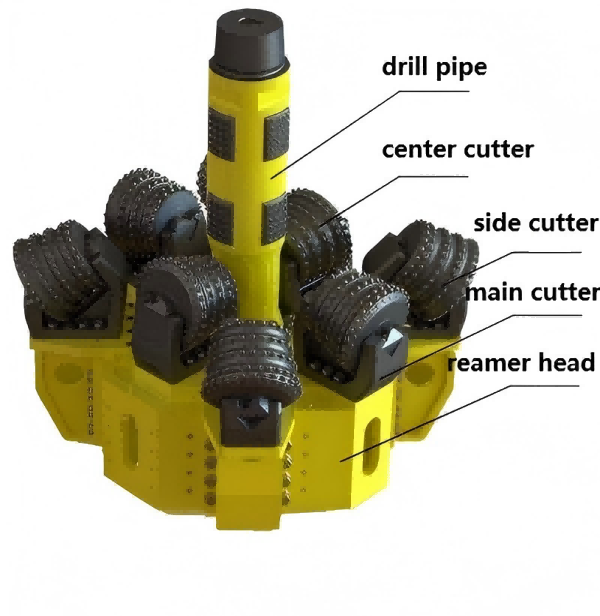
A typical reaming head consists of a high-strength alloy steel base and multiple roller cutters mounted on cutter seats. Connected to the mining drill rod string, the reaming head receives rotary torque and upward pulling force from the raise boring machine. As the equipment rotates and pulls upward, the roller cutters roll on the rock face, applying continuous compression and impact force to crush rock formations. Rock fragments fall through the clearance between the reaming head and borehole wall and are discharged from the shaft.
There are three common structural types of reaming head for mine projects: spoke type, cage type and disc type. Each variant is designed to fit different rock conditions, shaft diameters and geological complexity.
The quality of your reaming head directly affects project efficiency and operating cost. High-grade reaming head is manufactured from alloy steel with precise heat treatment, delivering excellent impact resistance and wear resistance. Reasonable layout of roller cutters balances rock breaking load and suppresses vibration during reaming, preventing early failure of cutters or structural deformation of the reaming head.
A major advantage of well-engineered mining reaming head is convenient on-site maintenance. Worn roller cutters can be replaced quickly without disassembling the entire reaming head, cutting downtime significantly and keeping your shaft construction project on schedule.
How to select the right reaming head for your raise boring project
Many factors should be considered before choosing a reaming head: target shaft diameter, rock compressive strength, excavation depth and the torque limit of your raise boring machine.
For hard rock like granite: Choose heavy-duty reaming head fitted with reinforced roller cutters to sustain heavy cyclic impact loads.
For fractured, soft rock strata: Pick reaming head with optimized chip removal channels to avoid rock debris clogging and hole sticking.
Regular inspections of cutter teeth, bearings and reaming head body cracks are simple but effective practices to extend the service life of your reaming head and reduce overall drilling expenditure.
Our reaming head products are fully compatible with mainstream raise boring machines and blind shaft drilling rigs. We supply standard and custom reaming head solutions covering a broad range of shaft sizes for underground mining, ore pass and hydropower tunnel projects. Whether you need a reaming head for small ventilation raises or large-diameter vertical shafts, our robust reaming head provides stable rock breaking performance to help mining contractors deliver safe and productive shaft excavation.