As the core rock breaking component of raise boring construction, raise boring drill bits mainly consist of pilot hole bits and reaming roller cutter bits. They directly determine the drilling efficiency, construction safety and overall cost of mine ventilation shafts and draw shafts. Just as extended drill pipes impose new requirements on the pipe handling system of petroleum drilling rigs, the structural features, dimensions and load characteristics of drill bits also impose constraints on the power head, drill string and tool handling devices of conventional raise boring rigs. Foreign raise boring drill bits boast a mature product system and can be flexibly matched with various rig models. Although domestic drill bit specifications have been continuously enriched, systematic research on their compatibility with existing conventional raise boring rigs remains insufficient. Mismatches between bit selection and rig parameters frequently trigger abnormal cutter wear, rig overload and reduced operational efficiency. Hence, research on bit rig adaptability is of practical significance for improving domestic raise boring performance.
1 Current Status of Raise Boring Drill Bits
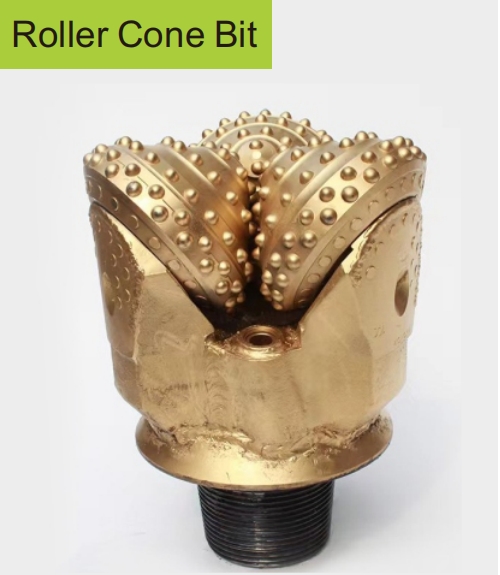
Raise boring drill bits cover a wide range of specifications, forming standardized series from small diameter pilot bits to large diameter reaming cutter heads. Roller cutters adopt multiple tooth profiles such as spherical inserts and wedge inserts, adaptable to formations ranging from soft rock to extremely hard granite. These bits are interchangeable between conventional rigs and special high torque raise boring rigs. Domestic raise boring drill bits are mostly applied under medium aperture working conditions, with cemented carbide inserted roller cutters as the mainstream. Their service life is inadequate in highly abrasive hard formations, and complete adaptability schemes for matching bits with conventional domestic rigs are lacking.
Properly matched with rig parameters, raise boring drill bits deliver prominent application advantages. Roller cutters crush rock through extrusion and rolling, eliminating blasting operations and greatly lowering underground personnel risks. Modular roller cutters facilitate on site replacement and maintenance, cutting the time for integral bit disassembly and assembly. Optimized tooth layout can reduce drilling torque and vibration, mitigate alternating loads on drill pipes, lower the risk of drill tool failure, shorten shaft sinking cycles and decrease comprehensive costs for mine shaft projects. Nevertheless, the increased mass and overall dimension of large diameter reaming bits bring new challenges to rig power head output torque, drill string bearing capacity and tool lifting handling devices.
2 Adaptability Analysis Between Drill Bits and Key Components of Conventional Raise Boring Rigs
Following the analytical approach for adaptability between extended drill pipes and drilling rigs, this paper focuses on the adaptability of drill bits to power heads, drill string systems and tool handling devices. Components with negligible impacts such as hydraulic pump stations are not analyzed in depth.
2.1 Adaptability Between Drill Bits and Power Heads
The power head serves as the power output unit of raise boring rigs, providing torque and axial weight on bit required for drilling. Adaptability mainly lies in connection interface dimensions, rated torque and allowable axial load. The flange connection dimensions of drill bits must match the output end of power heads to guarantee interchangeability. During reaming, the output torque of the rig shall satisfy the total torque demand for rock breaking of all roller cutters. Excessive rock breaking torque caused by over abundant roller cutters or improperly hard bit profiles will lead to bit stalling and shutdown when exceeding the rated output of the power head. Conversely, undersized bits fail to fully utilize rig capacity and result in equipment waste. Conventional raise boring rigs have upper limits for power head torque. When large diameter reaming bits are selected, total rock breaking torque shall be checked. If necessary, roller cutter quantity or tooth profiles can be adjusted without modifying the power head body.
2.2 Adaptability Between Drill Bits and Drill String Systems
Drill pipes bear tension, torque and the self weight of drill bits. Heavy weight reaming bits increase the maximum static load of drill pipes, while rock impacts during reaming induce alternating loads. On one hand, the tensile and torsional performance of drill pipe thread connections should be verified to prevent thread damage. On the other hand, bit vibration and deformation transmit to drill pipes. Calculations show that bits with reasonable specifications produce limited deformation under normal conditions. Alternating soft hard formations may cause significant lateral bit deformation under eccentric loads and amplify swing of drill pipe columns. For conventional drill pipes, stability requirements can be met with properly selected bits. In case of excessive bit eccentric deformation, bit tooth layout shall be modified or central stabilizers added to improve the stability of the drill tool assembly.
2.3 Adaptability Between Drill Bits and Tool Handling Devices
Tool handling devices perform lifting and positioning of drill bits and drill pipes. Adaptability constraints mainly originate from the overall outline dimension and total mass of drill bits. Conventional handling devices have load margins that satisfy mass requirements for most scenarios. However, large diameter reaming bits feature large outer profiles and may interfere with derricks and guide rails, leading to difficulties in lifting and positioning. No rig modification is required if bit dimensions fall within allowable handling ranges. Special lifting slings or partial adjustment of limiting structures are needed when bit dimensions exceed thresholds.
3 Field Application Case
A φ2.0 m draw shaft construction was carried out with a domestic conventional raise boring rig, adopting a cemented carbide inserted roller cutter reaming bit with a total mass of 8.2 t. The rated torque of the power head was 220 kN·m. Torque verification indicated that the maximum operating torque of the bit in target formations was 172 kN·m, satisfying power head output conditions. Standard high strength drill pipes passed tensile and torsional verification. Minor retrofitting of matched lifting slings for tool handling devices enabled bit lifting and positioning.
Field construction demonstrated favorable bit rig adaptability with stable drilling and controllable vibration amplitude. Compared with adjacent draw shaft projects under identical geological conditions, the optimally matched bit rig combination improved comprehensive drilling efficiency by 7%-11%, reduced unit advance wear of roller cutters, and cut single well drill tool maintenance costs by 6%-9%, verifying the effectiveness of the adaptability scheme.