
In vertical shaft sinking, raise boring stands out as one of the most efficient and secure excavation methodologies. However, underground operations are unforgiving. While the mechanical limits of the surface Raise Boring Machine (RBM) and the sharpness of the roller cutters are frequently discussed, there is an unsung role built into the face of every reaming head that determines whether a project succeeds or fails: the Raise Boring Cutter Block.
Commonly referred to in the field as the saddle, cutter pocket, or cutter holder, this component acts as the foundational baseline for downhole rock-breaking. This comprehensive article explores what a cutter block is, how it functions, the everyday engineering struggles faced by drilling crews, and how advanced manufacturing standards directly resolve these systemic downhole pain points to protect your operational budget.
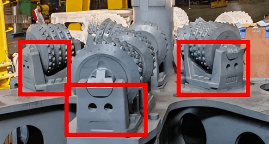
A Raise Boring Cutter Block is a heavy-duty, high-precision structural component welded or bolted directly onto the steel panel of a raise bore reamer (or pilot drill bit). Its primary purpose is to serve as the physical docking cradle for the rock-breaking roller cutters (hobs).
To understand its position, look at the layout of a reaming head. The reamer body is a massive steel frame, but it cannot hold raw rolling cutters directly on its shell. The cutters must be precisely positioned, angled, and locked down so they can roll concentrically against the rock face. The raise boring cutter block is the modular “bridge” that clamps the shaft of the roller cutter and holds it securely to the reamer body. Without this critical mid-tier raise boring cutter block, modular cutter replacement would be impossible, and the reaming head would have no structural means to house its cutting teeth.
The role of a cutter block extends far beyond acting as a basic metal bracket. In heavy-duty boring operations, it carries out four essential technical responsibilities:
When drilling teams go underground, the reality of the strata introduces severe mechanical issues. Field crews consistently battle major operational difficulties rooted in standard raise boring cutter block vulnerabilities:
Problem A: Mounting Bolt Shearing and Block Loosening
One of the most frustrating downhole failures is when the high-strength bolts securing the cutter block to the reamer panel snap cleanly in half. This rarely happens due to poor bolt quality. Instead, it occurs when there are microscopic gaps between the base of the block and the reamer panel. Under the constant pounding of rock breaking, these tiny clearances allow micro-rocking movements. This cyclic wobble creates intense fatigue stress, quickly shearing the bolts and causing the block to wobble loose.
Problem B: Structural Deflection and Energy Loss
When a reamer hits hard rock bands like quartz or granite, the resistance is immense. If a cutter block is made from cast steel or inferior alloy, it will experience microscopic flexing or bending under heavy load. This structural deflection causes the roller cutters to tilt out of their engineered path. As a result, energy is wasted within the bending steel rather than breaking rock, leading to dropped penetration rates and highly uneven cutter wear.
Problem C: Frictional Washout and Secondary Grinding
In highly abrasive formations, such as quartz-heavy sandstone, the rock dust generated during drilling acts like industrial sandpaper. If the cutter block profile does not clear debris quickly, the fallen rock chips get trapped. The cutters are forced to repeatedly crush the same debris—a process called secondary grinding. This generates intense heat and abnormal vibrations while rapidly eroding and washing out the steel walls of the cutter block itself.
Understanding these challenges highlights a simple reality: Your drilling advance rates are completely throttled by the structural limits of your cutter blocks.
If an operator tries to save costs by purchasing low-grade, non-calibrated cutter saddles, the financial consequences downhole are severe:
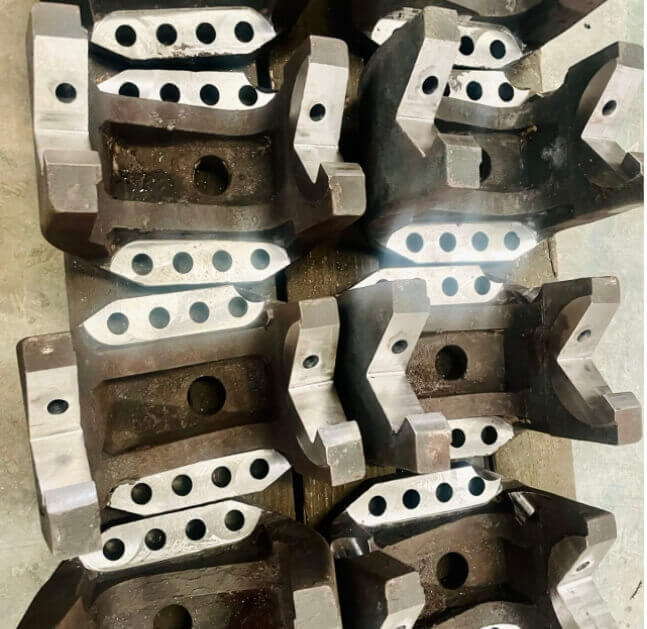 | Raise Boring Cutter Block | |
| Tensile strength | ≥1100 MPa | |
| Torsional stiffness | ≥500 kN·m/rad | |
| Interface flatness | ≤0.02 mm/m² | |
| Dynamic balancing accuracy | G2.5 (ISO 1940) | |
| Fast change support | Yes | |
| Material | Forged steel | |
To solve these exact field frustrations, the LOOKING raise boring cutter block is re-engineered from a traditional cutter holder into a high-precision, heavy-duty solution. We have matched premium material science with strict manufacturing tolerances to create a raise boring cutter block product line that directly eliminates downhole anxiety.
Every LOOKING raise boring cutter block is built from premium forged steel, achieving a certified tensile strength of ≥1100 MPa and an incredible torsional stiffness of ≥500 kN·m/rad.
We eliminate the root cause of bolt fatigue by ensuring our raise boring cutter blockfeatures an interface flatness tolerance of ≤0.02 mm/m².
To protect your surface rig from destructive harmonics, the LOOKING raise boring cutter block array is distributed and balanced to meet the precise G2.5 accuracy tier under ISO 1940 standards.
A successful project requires matching your tools to the local geology. The LOOKING raise boring cutter block offers specialized configurations engineered for distinct rock behaviors:
While LOOKING engineering drastically lowers your downhole risk, long-term tool success relies on standard field discipline. Maintenance crews should always implement two non-negotiable protocols:
Never allow crews to tighten block bolts by guesswork or loose impact wrenches. Always use a calibrated torque wrench to tighten all fastening bolts to the exact numerical specifications provided by the manufacturer. This prevents over-stretching or thread stripping under downhole vibrations.
Regularly inspect and calibrate the installation angle and radius of each cutter holder. Catching micro-shifts early ensures the rollers continue to run along their engineered path, protecting your bit from uneven tracking wear.
By combining premium forged steel architecture with modular Fast Change support, LOOKING Raise Bore Reamer Blocks allow field teams to swap out single worn components quickly with standard tools, reducing downtime and protecting your operational bottom line.