
Cutting slots create free faces for large-scale mining. They also provide free space. The excavation of these slots affects sustained production in underground mines. Cutting shafts serve as the initial free face and compensation space for blasting. Their construction quality directly impacts mining operations.
Currently, China mainly relies on short-hole blasting to build cutting shafts. This method involves repeated blasts. It has many challenges. These include long preparation times, high difficulty, poor conditions, low efficiency, and safety risks.
To overcome these challenges, China developed the CY-R40C multifunctional cutting shaft drilling rig. It has been widely adopted at many mines worldwide. The CY-R40C has shown excellent performance. It has also delivered significant benefits.
For a long time, China’s underground mines relied on manual and semi-mechanized methods. Work at the mining face has narrow cross-sections and harsh conditions. Workers face dangers from blast fumes, falling rocks, dust, noise, and water. This creates an extremely unsafe environment.
This safety issue grows as mining goes deeper. Ground pressure and temperature gradually increase. Productivity also remains extremely low. Underground space has few free faces and limited compensation space. This makes underground mining highly challenging.
Mines must excavate cutting shafts. These shafts serve as free faces and compensation spaces for blasting. They provide necessary conditions for blasting operations. The quality of the cutting shaft affects the quality of the cutting channel. This in turn influences the contour and block size of working face blasting.
Therefore, ensuring cutting shaft quality is crucial for successful mining. Using equipment to free workers from high-risk environments is also significant for safe and efficient production.
The CY-R40C is designed for excavating various shaft cuts. It can descend into the shaft and relocate on its own. It requires no concrete foundation. It is ready to use immediately upon arrival. It features quick relocation and installation. It ensures safe and efficient operation.
All technical specifications meet international standards. It fully meets process requirements for shaft-cutting construction in Chinese underground mines.
The CY-R40C features a modular design consisting of the main unit, track undercarriage assembly, folding boom crane, and power unit.
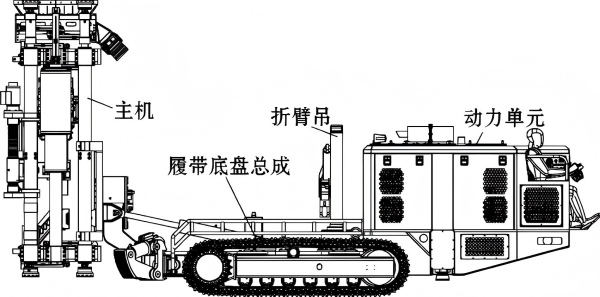
The main unit primarily comprises a manipulator,slewing drive assembly,propulsion and support mechanism,and guide mechanism.
Among these,the manipulator is used for the automatic gripping of drill pipes;the rotary drive assembly provides rotational torque;and the thrust support mechanism provides thrust and counter-lift force.
Its four upper and lower support mechanisms enable construction without the need for a concrete foundation—simply clear away loose rock,secure the support mechanisms as required,and begin operations,truly achieving“arrive and drill,finish and leave.The debris-guiding mechanism is used during upward cutting of the shaft to press the debris hopper tightly against the rock surface via lifting cylinders;cuttings generated during the drilling process fall directly into the debris hopper and are flushed through the cuttings discharge pipe to the surface via wash water.
The debris-guiding mechanism is used during upward cutting of the shaft to press the debris hopper tightly against the rock surface via lifting cylinders;cuttings generated during the drilling process fall directly into the debris hopper and are flushed through the cuttings discharge pipe to the surface via wash water.
Since stationary shaft drilling rigs used in modern trackless mines face significant difficulties when moving between sites underground—requiring disassembly,transportation,and reassembly—this time-consuming and labor-intensive process severely limits the widespread adoption of shaft drilling rigs in modern mines.
Therefore,a tracked undercarriage was innovatively developed to overcome the inconveniences associated with traditional drilling rigs,such as the need for disassembly during relocation,concrete foundation pouring,and reassembly,thereby significantly reducing the time required for relocation and positioning.
An articulated boom crane is used to replace manual labor in hoisting and handling drill rods,saving both time and effort.
The power unit serves as the power source for the entire machine,providing stable and reliable power for both operations and site relocation.

The hydraulic system of the CY-R40C Universal Boxhole Borer primarily consists of the advance-rotation hydraulic circuit, the auxiliary hydraulic circuit, the boom hydraulic circuit, and the travel hydraulic circuit. The entire machine employs a load-sensing hydraulic control system, which automatically adjusts the pump’s output pressure and flow rate based on load size and changes in actuator speed, thereby reducing system heat generation and ensuring energy efficiency and high performance.
The advance-and-rotation hydraulic circuit employs a power-controlled and load-sensing high-pressure hydraulic system. System pressure has been increased from the conventional 28 MPa to 35 MPa (maximum 40 MPa), resulting in a power density increase of more than 25 percent. The single-bit load capacity has been raised from the conventional 5 metric tons to 16 metric tons, enabling the machine to handle a wide range of complex geological formations.
The electrical control system of the CY-R40C consists of the RCS control system, main unit control circuit, and conventional control circuits. It combines CAN bus communication with wireless remote control. This offers high reliability, excellent interference resistance, and rapid response. All operating parameters display in real time on the screen. The interface is user-friendly and customizable. This ensures convenient operation.
The RCS control system includes a controller, a wireless remote control, input devices, and actuators. It can perform automatic positioning, pressurization, gear shifting, and optimization. With an intelligent control module, it can perform autonomous operations.
The controller receives commands from the wireless remote control. It verifies received signals and sensor feedback. Then it analyzes and processes data under an expert database. It issues reliable and safe execution commands to actuators.
Traditional shaft drilling rigs require manual insertion and removal of drill pipe wrenches weighing tens of kilograms, which is physically demanding for workers. The CY-R40C multifunctional slot-cutting shaft drilling rig employs fully mechanized drill pipe handling, enabling intelligent drill pipe handling operations without the need for assistance from others.
It features multi-point remote control operation and allows for single-operator, single-rig operation, significantly reducing auxiliary operation time, lowering the physical strain on workers, and minimizing the number of personnel required.
The shaft materials, heat treatment processes, drill pipe structure, thread profile, and pitch are based on patented technology. These result in higher load-bearing capacity and longer service life. The system addresses common cutter and cutterhead damage under high axial pressure and high torque.
It innovatively employs a V-shaped cutter mounting structure. It uses a combined bolt-pin-key positioning system for the cutter seat and cutterhead. It also uses a key-lock connection between the cutterhead housing and tie rods. These optimizations enhance the cutting tools’ ability to penetrate hard rock. They meet hard rock crushing requirements of metal mines.
This ensures stable, reliable, and efficient transmission of high shaft pressure and high torque. The roller cutter operates continuously under stable rated load capacity. This extends service life. It also significantly reduces operating costs.
The design applies transport vehicle design theory. It utilizes a dual-power drive system. This system uses diesel-powered travel and electric-powered operation. It leverages finite element analysis and dynamic simulation. The system employs hydraulic struts for stable positioning. It also uses dynamic pressure-maintaining PID compensation technology.
This enables the shaft drill rig to be ready for use immediately upon arrival. It overcomes inconveniences of traditional drill rigs. These include disassembly for relocation, foundation pouring, and on-site reassembly. It significantly shortens relocation and positioning time.
Cross-coupled track synchronization control technology ensures long-distance straight-line travel. This works in level tunnels and on inclines. It reduces operating difficulty. It increases average travel speed. It also enables rapid relocation.
When used in modern mines, traditional shaft drilling rigs—due to their large size—face difficulties in being transported underground and relocated, requiring disassembly, transport,and reassembly—a time-consuming and labor-intensive process that severely limits their promotion and application in modern mines.
Therefore, a shaft drilling rig with a modular design was developed. Consisting of three components—the power unit, the main unit, and the track undercarriage—it features a more compact structure, can adapt to mines with more complex operating conditions, reduces chamber excavation costs, and shortens the construction cycle.
The independently developed RCS3.0 Intelligent Control System is a high-end system for drilling rigs. It provides comprehensive support for on-site and client-side operations. It consists of hardware and software.
Hardware includes a host computer, PLC, display, sensors, communication components, storage media, an operator console, and actuators. Software includes a central control module, perception module, operation module, data storage and transmission module, display module, expert library, and host computer management module.
Guided by the expert database, the system’s PLC analyzes and processes collected data and commands. It issues reliable and safe execution commands to actuators. These actuators are hydraulic proportional valves or variable-displacement hydraulic pumps.
The system includes reserved interfaces for a host computer and data logging/storage. It is equipped with a dedicated RCSPC host computer system. This enables online data retrieval and analysis via PC. It also enables offline data storage on an SD card and report generation.
Users can access data at any time. This achieves superior human-machine interaction and data services. It better realizes safety protection, autonomous operation, data storage, fault diagnosis, remote monitoring, digital display, and report generation.
These primarily include deep-hole drilling, upward blind drilling, downward forward drilling, and downward reverse drilling.
The CY-R40C multifunctional boxhole drilling rig uses a roller cone bit to quickly and accurately drill upward or downward to create various types of large-diameter deep holes—such as drainage holes, ventilation holes, backfill holes, and cable holes—with diameters ranging from 215 to 310 mm and depths of up to 200 m.
In underground mining methods such as the stoping-with-subsequent-backfilling method and caving mining, upward-cutting shafts are commonly used to provide a free face and compensation space for blasting. The CY-R40C multifunctional shaft-cutting drill rig replaces manual excavation for upward-cutting shafts, offering greater safety and efficiency. Using a one-step shaft-forming process—where a roller cone bit drills ahead and a reaming cutterhead follows to break through the rock—it can excavate upward-cutting blind shafts with a diameter of Φ670 mm and a depth of 60 m.
When the bottom passage is not accessible to vehicles, the downward shaft forward excavation process is used. First, a roller cone bit is used to drill a pilot hole; after removing the bit and drill pipe, a Down-reamer Head is installed to perform top-down reaming operations, utilizing the pre-drilled pilot hole for guidance and muck removal. This method can be used to drill a cutting shaft with a diameter of Φ670 mm and a depth of 60 m.
In mining processes such as VCR, cutting shafts are required to provide buffer space for lateral blasting. Using a versatile, safe, and efficient cutting slot drill rig for shaft excavation is an ideal choice. The downward reverse shaft excavation method involves first drilling a pilot hole with a roller cone bit, then the drill bit is removed and replaced with a ream head to perform bottom-up reaming. This process can be used to drill a cutting shaft with a diameter of Φ1400 mm and a depth of 200 m.
The CY-R40C Multifunctional Cutting Slot Shaft Drilling Rig has been widely used in numerous mines both domestically and internationally, with a total drilling depth exceeding 10,000 meters and excellent performance.

In summary, the CY-R40C multifunctional shaft-cutting drilling rig addresses the technical challenges faced by small and medium-sized underground mines in China when constructing shafts in confined spaces. As an advanced shaft-cutting construction machine, it can significantly accelerate shaft construction when selected and used appropriately under suitable engineering and geological conditions, thereby replacing other shaft-cutting methods and resolving safety issues associated with shaft construction.